Showing posts with label jesus. Show all posts

WHO is God?

A response to message: Ten Commandments Controversy - America Founded on Judaic-Christian Priniciples

From: "ricky"
To: edwardtbabinski.us
Sent: Thursday, September 25, 2003 9:47 AM
Subject: WHO is G-d?

Gloria, I can see that you, like myself, are searching for the true G-d, because, for all these years, you have been inundated with conflicting information that has you confused and uncertain. Let me relate a true story of something that happened to me just last week that should help you find an answer.

For the past 35 years I have been an absolute atheist. Raised a Roman Catholic, I, of course, began to question the veracity of the scriptures and the authenticity of the new testament. It has been my belief that the story of Jesus was the greatest hoax perpetrated on mankind in all of history. NOBODY could convince me I was wrong. With this in mind, last week, Monday, September 15, I was checking out the stocks, looking for something to buy low and sell high, watching CNBC, when I realized it was time to take my granddaughter to the schoolbus, which has become a daily ritual for me. Before I disconnected from the trading site I said to G-d, "Father, I TRULY believe that YOU are the one true G-d and Jesus was not your son. I believe that Christians, believing otherwise, are breaking the first commandment. If I am on the right path, and YOU are the one TRUE G-d, please send me a sign...mess up my computer; leave a message across the screen....ANYTHING to give me a sign that I am on the right path."

I, then, shut down, went over to my son's house and picked up my granddaughter. After she wasdriven off, I returned home and returned to the very same website I had been on, only THIS time I couldn't submit a buy order, I couldn't browse, couldn't send or recieve EMail...in other words, my computer had gone haywire.

I packed up my equipment to take it to a computer expert to have it purged of this virus, and, later that night I was washing the supper dishes. My wife was gone, playing Bingo, and, as I rinsed a glass, with the TV on in the backround, I said aloud, "Well, G-d, I guess you showed me."

IMMEDIATELY, one of the characters, I think it was a woman, (and I really don't know what was being shown on the channel, or even WHICH channel I had on) said, "That's what you asked for, Ricardo". I know you must think I'm some lunatic, but the fact that I found your website should convince you that, since I experienced those two miracles, I have done little except try to find out whether this was truly a connection to the one, true G-d. Take it for what it's worth. I swear that EVERY word I have written here is the absolute truth. As hard as it is to go contrary to the Christian faith, I am CONVINCED now that the Jews and the Muslims might just be correct in their assertions that Jesus was no more than a man and that G-d is angry that this carpenter has been given a status
he does not deserve.

What do YOU think?


From: Gloria M.
To: edwardtbabinski.us
Sent: Sunday, September 28, 2003 9:44 AM
Subject: Re: Hello

I read, with interest, your miracle, and certainly will not argue with your interpretation.......except........when I read:
"later that night I was washing the supper dishes."

Now we all know that male/washing dishes do not belong in the same sentence. What planet did you say you live on?

Just joking, I also, have a husband who washes dishes - (lucky me) -

Now for your question: What do YOU think?

You know 'Ricky' it is not for me to question your interpretation of an experience that you call a 'miracle'. I will share with you that my computer crashed last year, and it did not occur to me to put a 'God did it' interpretation on it. - and I will say that I disagree with your characterization of God as 'angry' - (amused, maybe), but we've got to stop attributing to God all these negative human emotions - Isn't it amazing he has not sued for defamation of character a long time ago?

Sincerely, Gloria, ss (struggling soul)

Testimonies of Exorcism

From: Winston
To: ed.babinski
Sent: Sunday, July 18, 2004 7:02 AM
Subject: Link to my article debunking Christian fundamentalist arguments

Hi there,
I just put up my article debunking the main arguments of Christian fundamentalists. Here is the link. I was wondering if you could post it somewhere on your site. It was written to help newly ex-fundamentalists.

Debunking_Christian_Arguments.htm

Thanks,
Winston


From: Ed Babinski
To: Winston
Sent: Monday, July 19, 2004 2:37 AM
Subject: I read your testimony, Winston, very interesting!

Hi Winston,

Thanks for writing edwardtbabinski.us

I enjoyed your personal testimony about leaving fundamentalism at your website.

...especially this part: "My mom... took me to see some Spiritualist healers and Taoist-like temples to try to get help for the mental illness I had for 2 years. Three Different spiritualists who didn't know each other told her that they could 'see' two souls inhabiting me for a past karmic crime I committed against them. She was instructed by the leaders of a Taoist-like temple to perform these strange exorcism rites, which involved putting leaflet spells above the bedroom I slept in and having me take baths in some hot herbal water tossed in with yellow spell leaflets.

It was all weird to me and my Christian world view taught that Satan was behind these kind of things. But I thought oh well, being a Christian never helped me through those 2 hellish years anyway, so why not give Satan a chance at helping me?"

Your testimony parallels that of another former fundie friend of mine, Will Bagley, who lives in Washington state. Will was "born again," but later read the great Catholic mystics, then the great Eastern mystics, and today studies Taoism, vegetarianism, meditation, mental and bodily healing, life extension, channeling, massage, etc. Will sends out a regular e-newsletter on those topics. You two should meet for coffee and tell me all about what you discussed! Will's photo and testimony about how he left fundamentalism can be found in a book I edited, Leaving the Fold: Testimonies of Former Fundamentalists (Prometheus Books, 1995). Though my book was published by that skeptical organization, it included testimonies of former fundamentalists who remained Christians, though more moderate and liberal, as well as the testimonies of two folks who left fundamentalism for Wicca and eastern mysticism, respectively. Only the final third of the book contains the testimonies of former fundamentalists who ecame agnostics and atheists. I thanked Prometheus for including such a broad range of former fundie testimonies.

Today there is a great website run by Steve Locks that features the testimonies of many former fundies, possibly the most well indexed and widest collection of such testimonies on the web. His site is simply named, "Leaving Christianity." Easy to remember, check it out by simply googling, "Leaving Christianity." It's number one.

Will and yourself also agree that the skeptics are too skeptical. Will is quite well read and also quite deeply into spiritual practices, and I am sure you two will find much to talk about, wish I was there to listen! Maybe send me a cassette tape of your conversation! And play a game of chess too! Why not some speed chess? (Will once won the championship of a large prestigious chess club in New Jersey, but hasn't played in years. Like Will, I was a top ranked high school chess player.)

Cheers!
Edward T. Babinski


edwardtbabinski.us writes:
Did you hear the story on the news about a preacher who sat on an autistic boy's chest, the mother believed her son could be healed of the demon causing the illness...

Faith kills boy, 8.

An autistic eight-year-old boy has died during a prayer service held to supposedly cure him of the evil spirits blamed for causing his condition. "[We] didn't do nothing wrong," the pastor, David Hemphill, told the Milwaukee Journal Sentinel newspaper.

US boy dies during 'exorcism' An autistic eight-year-old boy has died during a prayer service held to supposedly cure him of the evil spirits blamed for causing his condition. Torrance Cantrell was wrapped in sheets and held by his hands and feet while members of the Faith Temple Church of the Apostolic Faith in the city of Milwaukee prayed over him. This procedure had been taking place three times a week. However, on Friday those involved in the ceremony - including his mother - noticed the boy had stopped breathing. Paramedics were called to the scene but were unable to revive him. The brother of the church's pastor, Ray Hemphill, who was also present at the ceremony, was arrested shortly after the incident on suspicion of physically abusing a child, local police said. "[We] didn't do nothing wrong," the pastor, David Hemphill, told the Milwaukee Journal Sentinel newspaper. "We did what the Book of Matthew said... all we did is ask God to deliver him." 'Tormented' Autism causes children to have severe problems relating to, and communicating with, people around them. In interviews with local newspapers, neighbours of the Cantrell family alleged that Torrance hated being touched and said that having people restrain him would likely have caused him a great deal of stress. However, David Hemphill said that the boy had been wrapped in sheets and had his shoes removed in order to prevent him from being hurt. "We were asking God to take this spirit that was tormenting this little boy to death," Mr Hemphill said. "We were praying that hard, but not to kill." David Hemphill started the independent church in 1997. It has a small congregation of six families. Story from BBC NEWS. Published: 2003/08/25 14:41:23 GMT © BBC MMIII

A Belief in Near Death Experiences

From: Kathy G.
To: Ed Babinski
Sent: Thursday, October 23, 2003 2:08 PM
Subject: Jesus

I wish there was something profound that I could say to make you change your mind about this man Jesus. I wish you could know him Like I do as a comforter, heavenly father, a friend that I can tell anything to, teacher, answerer of prayers.

You are missing so much without him in your life. My father is 91 years old and loves the Lord. I know that he will be gone before long and it gives me such great peace to know that he is Heaven bound. He always tells me, "the best is yet to come, and that's Heaven."

I truly believe he lived and died for me, and I am so humbled and grateful for that, all I want to do is tell others about his love for them.

I will be praying for you that someday your eyes will be opened and you too will know, as the Bible says, "the peace that passes all understanding."

Kathleen G.


From: Ed Babinski
To: Kathy G.
Sent: Thursday, October 23, 2003 4:03 PM
Subject: Re: Fw: Jesus

Dear Kathleen,

I sincerely appreciate the love with which your email to me was filled.

Robert Ingersoll, America's "great agnostic," used to remark that there were sometimes hundreds of people outside his home praying for his salvation. He didn't mind he said, because it was like a boy holding a girl's hand, it didn't do either of them any harm, so long as the boy didn't squeeze the girl's hand too tightly.

I don't even feel any desire to disagree with you, or try to convince someone such as yourself of anything other than the joy you have found in your present beliefs, just as I wouldn't seek to convince anyone of any religion to leave it if they were wearing it fully, and practicing love as a result.

A mystical friend of mine who used to be a fundamentalist Christian once wrote in LEAVING THE FOLD that religion was like a cloak or clothes that you had to put on fully to see how they fit, and in the end after entering fully into love and also growing to recognize that love in others of other religions, and even in people of no religion, that cloak would grow lighter and lighter until you didn't even realize you were wearing it, but merely that you were a member of all faiths and non-faiths that practiced love.

Gandhi used to say that Christian missionaries shouldn't be trying to get people to leave their major religious faiths to become "Christians," but people should be trying to encourage each other to travel deeper into the heart of love that is found in all religious traditions and holy books. (See the book titled, ONENESS, a small volume, that mentions such verses in all the world's major religious traditions.)

So many faiths that wind and wind,
yet what the world needs most
is just the art of being kind.

Lastly, I am not an atheist, but think there may be something to Near Death Experiences.

Best, Ed


From: Kathy G.
To: Ed Babinski
Sent: Friday, October 24, 2003 3:56 PM
Subject: Near Death Experience

Thank you for your answer to my e-mail. You mentioned near death experiences. A few years ago I worked in an office with ten men. One of these men was a 37 year old by the name of Gene Mose. Gene underwent surgery on his foot in November of that year and as a result he got a very bad staff infection that put him in the hospital for 6 weeks. By January they realized that he had developed a heart problem and they immediately did heart surgery to replace a bad valve. During the surgery his heart stopped three times.

When he came back to work he came to my office one day and said, "Kathy, I want to share something with you. I don't feel I can tell any of the guys my story because they will think I'm nuts, but I know you will believe me." He then told he how when his heart stopped, his spirit rose above his body and he watched the surgeons frantically trying to save him. He said, "Kath, I saw Linda (his wife) sitting in the waiting room, I saw people going up and down the halls, and heard everything that was being said and done to save me. But the best part was the complete feeling of peace and joy and love that surrounded me during that time. I could feel the presence of God all around me and I really didn't care to come back. Noone will ever convince me there isn't life after death." He said, Do you think I'm nuts, Kath?"

I told him of course not. He said, "everything was as real as my sitting here talking to you today, and when they got my heart started my spirit went down until it was back in my body again."
That was in January of that year, and in August he layed down on the couch one night and died. Only 37, but he was ready to meet the Father.

If I had one wish in this life it would be that every person in the world would know beyond a shadow of a doubt what lies beyond this life. I'm sure we'd all live differently.

Sincerely, Kathleen G.


From: Ed Babinski
To: Kathy G.
Sent: Friday, October 24, 2003 4:29 PM
Subject: Re: Fw: Near Death Experience

Thanks, I love hearing about such things. Who is your friend? He should contact Raymond Moody, the author of the bestseller, Life after Life, or Dannion Binkley, author of Saved by the Light (I think that was the title). They are not evangelical Christians, but they collect Near Death stories. Moody has an institute for such things up in North Carolina. Their studies revealled to them that one's religion didn't matter. You could be an evangelical Christian or something completely different, and still feel the love and the recognition that there was life after death. And yes, along with your friend I wish everybody got to experience that kind of happiness in the midst of suffering, pain and death, it would bring a lot of us closer together here on planet earth.

Or on the other hand, perhaps it would also make some of us ignore those who are suffering, since they knew they'd be going to a better place? Hmmm. A wise rabbi was once asked if there was any time in which it was best to think like an atheist, and he said "Yes, there is one time when it is appropriate to think like an atheist, in the giving of charity, since you must not imagine that God is going to right all wrongs and take care of the poor and suffering."

That being said, I still think that if everyone had such an experience as your friend, the planet would be a happier better place, with less fear and tension. Certainly if Irish Catholics and Irish Protestants both had it, along with Muslims and Christians and atheists and agnostics, then people could speak of their shared experience. On the other hand, some fundamentalist Christians and Muslims might still find ways to denounce each other's experience as "fake" or "phoney" or "of the devil." I know there are some fundamentalist Christians like Habermas who co-wrote a book on The Afterlife in which he argued that all of those positive loving and life-changing NDEs that non-evangelical Christians have are all a "delusion" and don't mean those people are going to avoid hell.

Best, Ed

End Times Prophecies

troy wrote:
I was wondering if you can steer me to some books and/or websites that critically examine the Evangelical end times stuff. You know, the Hal Lindsay, Tim La Haye style end times doctrines about barcodes, microchips, The Beast, New World Order, etc. Whether it be liberal Christian or secular in origin, I want to see something that challenges this stuff. I need to deprogramme myself of this shit. Thanks. TROY

Dear Troy,
Thanks for writing. Hope these articles help:
How Do I Deal with the Multitude of Prophetic [End Times] Passages?

THE LOWDOWN ON GOD'S SHOWDOWN

ARMAGEDDON NOW! The Premillenarian Response to Russia and Israel Since 1917

Also, some of my favorite stuff on the subject below.

According to the Gospels, the man from Nazareth virtually never used the word "church." There are no sayings of Jesus spoken in public that programmatically call for a community of the elect and for the founding of a church. Biblical critics are agreed on this point: Jesus did not proclaim a church, nor did he proclaim himself, but the kingdom of God. Governed by the awareness of living in an end time, Jesus wanted to announce God's imminent kingdom.
Hans Kung, The Catholic Church: A Short History


The whole of Jesus's work implied that the apocalypse was imminent; some of his sayings were quite explicit on the point. The prima facie view of the Jesus mission was that it was an immediate prelude to a Last Judgment. Hence the urgency of the pentecostal task, an urgency which Paul shared throughout his life ["...brethren, pray for us that the word of the Lord may spread rapidly..." 2 Thes 3:1], so that his final hope was to carry the good news, while there was still time, to Spain - - for him, "the ends of the earth."

Paul Johnson, A History of Christianity (New York: Atheneum, 1979), p.38.

This poor deluded lady believed "Jesus is coming soon", so earnestly, she had it printed on her car door -- but Jesus didn't come, and that picture was taken around 1940.

"Get Ready" the door boldly proclaims.
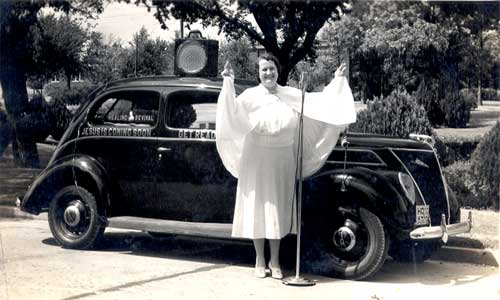
Jesus is not coming back.

EXCERPTS FROM "THE FALL OF FANATICISM" BY VOLTAIRE
(WITH ADDITIONAL VERSES AND COMMENTARY BY E.T.B.)

Jesus allegedly told the people of his generation:

The sun shall be darkened, and the moon shall not give her light, And the stars of heaven shall fall, and the powers that are in heaven shall be shaken. And then shall they see the Son of man coming in the clouds with great power and glory. And then shall he send his angels, and shall gather together his elect from the four winds, from the uttermost part of the earth to the uttermost part of heaven . Verily I say unto you, that this generation shall not pass, till all these things be done.
- Mark 13:24-27,30-31 (Compare the parallel verses in Matthew 24:29-31,34)

Luke echoed Mark and embellished the prophecy further:

And there shall be signs in the sun, and in the moon, and in the stars; and upon the earth distress of nations, with perplexity; the sea and the waves roaring; Men's hearts failing them for fear, and for looking after those things which are coming on the earth: for the powers of heaven shall be shaken. And then shall they see the Son of man coming in a cloud with power and great glory. Verily I say unto you, This generation shall not pass away, till all be fulfilled.
- Luke 21:25-27,32

Generations passed, and if none of those things happened it is not my fault. When it was seen what a gross falsehood had been put forward, the Fathers of the Church asserted that Matthew, Mark and Luke had meant by these predictions the fall of Jerusalem. But what connection is there, I ask you, between the fall of Jerusalem, and Jesus coming in the clouds with great power and gathering his elect from the four winds?

The apostle Paul, like Mark, Matthew and Luke, indulged in equally gross falsehoods when he predicted:

The rulers of this age...are passing away ["will not last much longer"--Today's English Version]...Do not go on passing judgment before the time [i.e., "before the time" of final judgment], but wait until the Lord comes [i.e., the Lord will come soon enough to relieve the members of that church from having to "pass judgment"] who will both bring to light the things hidden in the darkness and disclose the motives of men's hearts...The time has been shortened so that from now on those who have wives should be as though they had none . and those who use the world, as though they did not make use of it [i.e., Paul is warning his first-century brethren that the time has grown so "short" that they should no longer be overly concerned with marriage or buying or selling, but instead be preparing above all for the soon return of Christ]; for the form of this world is passing away ["This world, as it is now, will not last much longer"--Today's English Version]. These things were written for our instruction, upon whom the ends of the ages have come. Proclaim the Lord's death until he comes [i.e., Paul did not say, "Proclaim the Lord's death until the day you die," but rather, "until he comes," which means that he considered Christ's coming to be nearer than the time when the Christians he was addressing would all be dead, and he further emphasizes this by adding.] We [Paul and the first-century Christians being addressed] shall not all sleep. At the last trumpet. the dead will be raised. and we shall be changed [i.e., "we" included Paul and others whom he predicted would still be alive at Jesus's coming and hence not require "raising," but merely "changing"]. Maranatha [="Come Lord"]
- 1 Corinthians. 2:6; 4:5; 7:29-31; 10:11; 11:26; 15:51-52; 16:22

To the Philippians Paul wrote:

He who began a good work in you [the first-century Christians being addressed] will perfect it until the day of Christ Jesus [i.e., rather than saying "until the day you die," which Paul predicted was not going to happen to all of them as Paul pointed out in 1 Cor., "we shall not all sleep"]...In order to be sincere and blameless until the day of Christ [Compare 1 Tim 6:14, "Keep the commandment...until the appearing of our Lord Jesus Christ."]. We eagerly wait for a Savior, the Lord Jesus Christ...Let your forbearing spirit be known to all men. The Lord is near.
- Philippians 1:6,10; 3:20; 4:5

To the believers in Rome Paul wrote:

The sufferings of this present time are not worthy to be compared with the glory that is soon to be revealed to us...The whole creation groans and suffers the pains of childbirth together until now...We...groan within ourselves, waiting eagerly for our adoption as sons, the redemption of our body. knowing the time, that it is already the hour for you to awaken from sleep; for now salvation is nearer to us than when we believed! The night is almost gone, and the day is at hand...The God of peace will soon crush Satan under your feet.
- Romans 8:18,22-23; 13:11-12; 16:20

Moreover, Paul's earliest known letters were written to Christians of Thessalonica who were growing increasingly concerned because some of their brethren had died already without seeing the "coming of the Lord." Paul wrote to reassure them that the Lord would return soon:

For this we say to you by the word of the Lord, that we who are alive and remain until the coming of the Lord [i.e., Paul included himself as one who would be alive at the coming of the Lord]. shall be caught up together. in the clouds to meet the Lord in the air. May your spirit and soul and body be preserved complete without blame at the coming of our Lord Jesus Christ.
- 1 Thessalonians 4:15-17; 5:23

It is a righteous thing with God to recompense tribulation to them that trouble you; And to you who are troubled rest with us, when the Lord Jesus shall be revealed from heaven with his mighty angels [i.e., the Lord Jesus would be revealed from heaven with his mighty angels soon enough to recompense tribulation to whomever was troubling that first-century church!]. the mystery of iniquity doth already work. Brethren, pray for us that the word of the Lord may spread rapidly.
- 2 Thessalonians 1:6-7; 2:7; 3:1

Let each person ask himself here: could it be possible to see the stupidity of fanaticism pushed further? Not only has Jesus been introduced upon the scene predicting the end of the world in his own time but such was the fanaticism of all those who are called apostles and disciples. I have already mentioned the case of Paul. Let us look at the rest.

Peter in the First Epistle attributed to him says:

He [Jesus] was foreknown before the foundation of the world, but has appeared in these last times [or last days, or, end of times]...The end of all things is at hand . the glory that is soon to be revealed.
- 1 Peter 1:20; 4:7; 5:1

When Jesus did not return, the church had to deal with "mockers" who pointed to the false predictions of Jesus's soon return in the New Testament. In order to deal with such folks--who knew a false prophecy when they read one--a feeble attempt was made to explain Jesus's delay in a second letter attributed to the apostle Peter, which stated:

With the Lord one day is as a thousand years, and a thousand years as one day.
- 2 Peter 3:8

But this feeble attempt to silence the "mockers" fails miserably. It is like admitting that when God "inspired" the writers of the New Testament to proclaim that they were living in the "last hour," in the "last days," and that it was only a "very little while" before "He who is coming will come" (Heb. 10:37), that God really meant "last hours" and "last days" and "very little whiles" that were "thousands" of years long. I wonder what such an explanation implies about God's inability to put words into his prophets' mouths that meant what He truly intended, instead of having to cover His tracks in a late-dated letter like 2nd Peter? In short, the statement in 2nd Peter contradicts 1st Peter, and other New Testament predictions that Jesus (or "the Son of Man") was to come soon and initiate the world's final judgment.

Even the author of 2nd Peter did not suspect that the end was far off, for he wrote:

God is not slack concerning his promise.what manner of persons ought you [the second-century Christians he was addressing] to be...looking for, and hastening the coming of God...we are looking for new heavens, and a new earth.
- 2 Peter 3:9-13

And added:

...in the last days mockers will come with their mocking, following after their own lusts, and saying, "Where is the promise of his coming? For ever since the fathers [the earliest Christian leaders] fell asleep, all continues just as it was from the beginning of creation." For when they maintain this, it escapes their notice...
- 2 Peter 3:3-5

Speaking of "escaping their notice" (sic), it often escapes the notice of Christians as they read the above verses that they apply to "mockers" who were disturbing the faithful at the time 2nd Peter was written. So if the warning was about "mockers" who will come "in the last days," such mockers had arrived as early as the second-century, and were already asking, "Where is the promise of his coming?"

The First Epistle attributed to John says:

The darkness is passing away, and the true light is already shining...The world is passing away ["This world, as it is now, will not last much longer" - Today's English Version]. Children, it is the last hour; and just as you heard that Antichrist is coming, even now many Antichrists have arisen; from this we know that it is the last hour. [Notice the way the author emphasized the fact that not just a single Antichrist had arisen, but "many" Antichrists had already arisen, and pounded that point home to add weight to his prediction that "it is the last hour," and, "this world will not last much longer."]
- 1 John 2:17,18

The Epistle attributed to Jude, proclaims the same mania:


Certain persons have crept in unnoticed [i.e., they "have" already crept in, in Jude's own day], those who were long beforehand marked out for condemnation . about these [i.e., "these," refers to the people who have already crept in] Enoch prophesied saying, "Behold, the Lord came with many thousands of his holy ones to execute judgment [i.e., the Lord was going to come soon with thousands of holy ones to execute judgment on people who had already crept into the church in Jude's day]."
- Jude 4,10-15

The Epistle of James speaks likewise:

Come now, you rich, weep and howl for your miseries which are coming upon you [directed at the rich people living in James's own day]...It is in the last days that you have stored up your treasure . Be patient, therefore, brethren, until the coming of the Lord . for the coming of the Lord is at hand...behold, the Judge is standing right at the door.
- James 5:1,3,7-9

This ridiculous idea survived century after century. If the world did not end under the first Christian Emperor, Constantine, it had to end under Theodosius; if the end had not come under Theodosius, it had to occur under Attila the Hun. And up to the twelfth century this idea enriched the monasteries. A great many of the charters and donations to the monasteries began thus: "Christ reigning, the end of the world approaching, I, for the remedy of my soul, etc."


GIMME THAT OLD FALSE PREDICTION, IT'S GOOD ENOUGH FOR ME
The author of the letter to the Hebrews began his letter, "...in these last days," and argued on such a basis that, "He (Jesus) would have needed to suffer often since the foundation of the world; but now once at the consummation He has been manifested to put away sin by the sacrifice of Himself." With equal fervor he employed the phrase, "as you see the day drawing near."--and made the prediction, ".for yet a very little while, He who is coming will come, and will not delay." (Heb. 1:2; 9:26; 10:25,37) Oops! There's been a sleight delay.

Even worse is the fact that "at the consummation" can also be translated, "at the end of the age." What does that phrase mean, "the end of the age?" A verse in the Gospel of Matthew defines it precisely: "At the end of the age...the Son of Man will send forth his angels, and they will gather out of his kingdom all stumbling blocks, and those who commit lawlessness, and will cast them into the furnace of fire; in that place there shall be weeping and gnashing of teeth. Then the righteous will shine forth as the sun in the kingdom of their Father." (Mat.13:40-41 - the author evidently based his description of "the end of the age" on Daniel 12, which was a description of the final judgment of mankind) So that is exactly what the author of Matthew and the author of Hebrews predicted would happen in their day, i.e., the final judgment of mankind.

Also note the logic behind the argument in Hebrews 9:26. The author argued that continuous sinning "since the foundation of the world" required blood sacrifices "often." But God saw to it that Jesus's sacrifice occurred at a time when no further sacrifices would be required. That time could only be "at the consummation" or "at the end of the age" when the time of final judgment for all sinners had arrived. Thus he hoped to persuade his readers of God's wonderful plan in having Jesus sacrifice himself "in these last days," and that it was only a "very little while" before "he who is coming will come, and will not delay." It would appear even to the most dense that the prediction has failed. So, the author of Hebrews was a false prophet.
E.T.B.


THERE'S NO REVELATION LIKE A FALSE REVELATION
The book of Revelation begins with this prediction, "The revelation...which God gave to show...the things which must [shortly] take place." (1:1) The author, having addressed his letter to several churches in Asia Minor, circa 65-95 A.D., continued, "He is coming with the clouds, and every eye shall see him, even those who pierced him. Repent therefore; or else I am coming to you (the church at Pergamum) quickly, and I will make war against them with the sword of my mouth...(To the church at Thyatira) hold fast until I come. Because you (the church at Philadelphia) have kept the word of my perseverance, I will keep you from the hour of testing which is about to come upon the whole world. I am coming quickly...hold fast what you (Philadelphia) have." (1:7; 2:16; 2:25; 3:10-11)

In the final chapter of Revelation the author repeats his first chapter prediction of Jesus's soon coming, "...God. sent His angel to show...the things which must shortly take place...I am coming quickly...do not seal up the words of the prophecy of this book, for the time is near...I am coming quickly, and my reward is with Me, to render to every man according to what he has done [see the definition of the "end of the age" discussed above = the final judgment in Daniel and Matthew]...Yes, I am coming quickly...Come Lord Jesus." (22:6,7,10,12,20)

The idea of being either "sealed up" or "not sealed up" is something that the books of Revelation and Daniel both share. According to the author of the book of Daniel he was commanded to "seal up" his book "until the end of time": "Conceal these words and seal up the book until the end of time. these words are concealed and sealed up until the end of time." (Daniel 12:4,9) The book of Daniel was composed from the alleged point of view of a Jew living in ancient Persia who had visions of "the end of time," or, "the end of the age," when all men would "rise again" and be judged. (12:2,13) "Seal up the book," he was commanded, or so the story goes.

But the author of Revelation was told, "Do not seal up the words of the prophecy of this book," adding that what is revealed in it "must shortly take place." The intent of the author of Revelation in alluding to the "non-sealing" of his book is obvious, the author believed and predicted that Jesus was about to "come" and judge the world "quickly." So, the author of Revelation was a false prophet. And, by the same token, so was the author of Daniel, since his book was "unsealed" long before "the end of time."
E.T.B.

For 2000 years they've been saying Jesus is coming.

These poor folks sincerely believed "Prepare to meet thy God" -- but God never came.

Jesus is not coming back.

If Jesus and his apostles, for whatever motives, were mistaken in a matter of this consequence, how could I be certain that any one of them may not be mistaken in any other matter? If they were not inspired in what they said in their writings concerning the soon coming of Christ; how could they be inspired in those arguments they built on a foundation far from being so?
Matthew Tindal, Christianity as Old as Creation, A Republication of the Religion of Nature, 1730


ON THE KNOWLEDGE OF BIBLICAL PROPHETS
The Biblical prophets wrote book after book and epistle after epistle, yet never once hinted at the existence of a great continent on our side of the water; yet they must have know it was there, I should think.
- Mark Twain

Though Saint Augustine seemed inclined to yield in regard to the sphericity of the earth, he fought the idea that men exist on the other side of it, saying, "Scripture speaks of no such descendants of Adam." He insists that men could not be allowed by the Almighty to live there, since if they did they could not see Christ at his second coming descending through the air. But his most cogent appeal, one that we find echoed from theologian to theologian during a thousand years afterward, is to the nineteenth Psalm, and to its confirmation in the Epistle to the Romans; to the words, "Their line has [already] gone out through all the world, and their words to the ends of the earth." He dwells with great force on the fact that St. Paul based one of his most powerful arguments upon this declaration regarding the earliest preachers of the gospel (Rom. 10:18), and that, as those preachers did not go to the opposite side of the earth to preach the gospel, no people must exist there; hence those who believe such things, "give the lie direct to King David and to St. Paul, and therefore to the Holy Ghost." Thus the great bishop taught the whole world for over a thousand years that as there was no preaching of the gospel on the opposite side of the earth there could be no human beings there.
- A. D. White, A History of the Warfare of Science with Theology in Christendom, Vol. 1


THE NEW JERUSALEM
The last book of the Bible mentions a fabulous city called the "New Jerusalem":

And the city lieth foursquare, and the length is as large as the breadth. twelve thousand furlongs [about 1500 miles according to most commentaries]. The length and the breadth and the height of it are equal.
- Revelation 21:16

In other words the New Jerusalem is a gigantic cube and it is supposed to descend out of heaven. The author who wrote about the city apparently made it of such gargantuan proportions so that the length of just one of its sides was equal to the distance from Jerusalem to the capital and heart of the Roman Empire. Or perhaps the author had in mind that God meant to flatten Rome just as Rome had flattened God's holy temple in Jerusalem in 70 A.D.?

Other questions also come to mind: Wouldn't a cube that was 1500 miles on all sides simply see-saw on the earth's curved surface, since the earth is not flat, but a sphere? Even if it didn't see-saw and settled onto the surface of the earth gently, would not its sheer mass cause the earth's crust to buckle or crack beneath it, and initiate earthquakes or volcanic eruptions? Wouldn't it also cause a wobble in the earth's daily rotation? (Just try gluing a small cafeteria-sized carton of milk to a large bowling ball and spin the bowling ball to see what I mean.) How could a cube that was 1,500 miles on each side maintain its cubic shape since much smaller objects in space that are merely 400 miles in diameter, collapse into spherical shapes due to the force of their own gravity? And, what would prevent the city, after it landed, from growing as wide and flat as any mountain range due to its mutual attraction with the earth's own gravity?

And the New Jerusalem is so tall it would extend 1,300 miles further out into space than the International Space Station that is situated only about 200 miles above the earth. In fact the New Jerusalem would block jet streams in the upper atmosphere, and be pummeled by natural and man-made objects orbiting the earth, as well as its topmost floors being hit by solar winds and radiation. If you happen to live on any floor higher than merely the first 100 miles above sea level, I wouldn't suggest opening your windows without first donning a space suit.

Do the questions end there? No. Here's another: The author of the book of Revelation wrote that the "twelve gates" of the New Jerusalem are "twelve pearls; every gate is of one pearl." (Rev. 21:21) Hence the slang expression for heaven, "The pearly gates." But where can you find "one pearl" large enough to make a "gate" for a city that size? I'd pay money to see the oyster that popped those babies out! It must be bigger than one of the biggest animal of all time, the blue whale.

Of course some Evangelical apologists like Grant R. Jeffrey simply assume that the description of "The New Jerusalem" must be true without a doubt because "what reason would God have for describing such details so precisely unless they were true?" [Apocalypse: The Coming Judgment of the Nations (Bantam Books, Toronto, 1994), p.351] But then, who ever said "God" was the one describing such details? And who ever said that human writers didn't have imaginations capable of adding details to a story? Maybe the author of the book of Revelation assumed like most people of his day that the earth was flat [see NOTE], so a cube-shaped object would sit securely and squarely on it? He probably also made the New Jerusalem a cube because that's how the holy of holies of Solomon's temple was shaped. The author of Revelation, probably had no idea that the enormity of the city he had envisioned would raise scientific questions in the minds of 20th-century readers, especially since he probably assumed that the heavenly abode of God and angels existed not very far overhead, instead of that region being filled with orbiting bits of matter, solar radiation, and the vacuum of space? [See the section, THE HOLY HEAVENS OF THE HEBREWS] Finally, maybe Grant R. Jeffrey should cease making a career out of trying to anaesthetize the frontal lobes of people's brains, and embark on an expedition to find that oyster that pops out pearls as big as city gates? And he had better hurry and find that whale-sized oyster before King Kong enjoys it as an appetizer. (But where is Kong going to find a lemon large enough to squeeze on it?)

[NOTE] The author of the book of Revelation wrote in flat earth fashion: "I saw four angels standing on the four corners of the earth" (Rev. 7:1); and added elsewhere, "There was a great earthquake...and the stars of heaven fell unto the earth, even as a fig tree casts her figs when she is shaken of a mighty wind." (Rev. 6:12,13). "Stars of heaven falling to earth" after the earth below has been "shaken," mirrors the way that the sun, moon, and the stars are portrayed in the creation story in Genesis, being "made" and "fixed" above the earth. And just as those stars were "fixed" there, they would one day "fall to earth" like "figs" from a shaken tree after the earth below had experienced "a great earthquake," because to the ancient Hebrews the whole of creation consisted of a cosmos whose two halves were the earth below and the heavens above.
E.T.B.

If "Christ is the Answer", what was the question?

I guess after telling people for 2000 years "Jesus is coming" and he never came, and people stopped believing -- the answer is get "bigger speakers" then they'll listen.

Jesus is not coming back.

Will Christ ever return? The New Testament is now older than the Old Testament was when the New Testament was written, and still no word from the God of the Bible. So, what's holding Jesus up? (Subtract two points if you answered, "The nails in his hands.")
E.T.B.

Troy,
Also consider that the alleged "end times" prophecy of Ezekiel, included his fears of "foes from the northern frontier" by the names of "Gog and Magog," and those names have been identified in ancient writings as referring to ancient Scythian tribes that existed back in Ezekiel's day, not ours. Ezekiel was focused on fears of his day, not ours. Ezekiel's prophecy about their weapons burning for "years" after that momentous "end times" battle only listed wooden weapons and not very advanced ones either, not even a crossbow is mentioned, nor gunpowder. And in Revelation, another alleged "end times vision" as interpreted by folks like LaHaye, Revelation mentions "servants=slaves" and "chariots" existing in "Babylon" when Jesus "comes quickly."

Cheers,Ed

Original Thoughts on The Original Sin

(The 'Methodists') demonstrate to secure, contented, happy mankind that it is really unhappy and desperate, and merely unwilling to realize that it is in severe straits it knows nothing at all about, from which only they can rescue it. Wherever there is health, strength, security, simplicity, they spy luscious fruit to gnaw at or to lay their pernicious eggs in. They make it their object first of all to drive men to inward despair, and then it is all theirs.
- Deitrich Bonhoeffer, Letters and Papers from Prison


Evangelical Christianity: Being made to feel sinful and guilty for not having felt sinful and guilty, in order that one might experience release from sin and guilt; Like donning lead boots and walking about in them until totally exhausted in order to have the exhilarating experience of taking them off again.
- Conrad Hyers, Once-Born, Twice-Born Zen


IS THE HEART OF MAN DECEITFUL ABOVE ALL THINGS, AND DESPERATELY WICKED?
According to the Gospel of Matthew, Jesus taught, "If you see a woman and lust after her, I say that you have already committed adultery in your heart." In other words, even if you don't commit adultery in the flesh, you've committed it just by lusting after someone. Now suppose you see someone in need, who needs some cash or a kind word, and you yearn in your heart to give it to them, but don't. Does that mean you have already committed "charity" in your heart? Think about it. If a lust-filled yearning is evidence of the depravity of the human heart, then what about the yearnings people feel to help one another? Is that not an indication of goodness in people's hearts?

Gandhi, the famous Hindu peace-activist, taught that people should seek out what was best in their own religions and hearts. Even Jesus put a positive spin on "the heart" when he taught that "The good man brings good things out of the good stored up in his heart" (Luke 6:45 & Mat. 12:35), and when he taught that people ought to "Love God with all thy heart," (Mat. 22:37).

No doubt the "wickedness" of "the heart" expressed by Jeremiah 17:9 ("The heart is deceitful above all things, and desperately wicked") certainly applies to some people at some times when they do certain things, especially when they are at their lowest and weakest points. But to take Jeremiah's hyperbole and bake it in an oven until it becomes as dry and hard as a brick of dogma, and make that brick a cornerstone of your theology, takes a genuinely deceived heart, a heart dry of true feelings and honest appraisals of others' beliefs and actions.
- Skip Church


One of Christianity's chief offenses is not that it has enlisted the services of bad men, but that it has misdirected the energies of good ones. The kindly, the sensitive, the thoughtful, those who are striving to do their best under its influence, are troubled, and consequently often develop a more or less morbid frame of mind. The biographies of the best men in Christian history offer many melancholy examples of the extent to which they have falsely accused themselves of sins during their "unconverted" state, and the manner in which harmless actions are magnified into deadly offenses.
- Chapman Cohen, Essays in Freethinking


The church must stop trying to act like a "spiritual pharmacist" - working to produce acute guilt, and then in effect saying, "We just happen to have the remedy for your guilt here in our pocket."
- Dietrich Bonhoeffer

Changes we undergo "without knowing why"

Changes we undergo "without knowing why"
by Edward T. Babinski

Kate: I started to lose interest in many things for no apparent reason---I quit smoking, I quit drinking, I quit shagging, I even quit using profanity, all without knowing why. This building pressure was driving me buggy.

Ed: We all adjust to whatever group we belong to, or even visit. It's a subtle fact of us being social creatures. If you became a BOB JONES UNIVERSITY type of Christian, and were a male, then you'd probably cut your hair above the ears too, "without knowing why," and thinking it was due to "God's supernatural inducements." In fact, a guy from Bob Jones with a Ph.D. in Bible Studies from that college and who edits Bible Review wrote me a letter and told me that exact story, that he "didn't know why" he cut his hair for God, but he just did, and felt "better" afterwards, even though nobody in the church had "told him" to do it. Of course the fact the he was the only one wearing long hair in his church and his brother had cut his hair earlier had nothing to do with that "supernatural revelation" that his hair ought to be shorter than it was. Or if you became a BOB JONES type Christian you'd probably dress more demurely as a female than you do now, nothing but skirts a little above the ankles, "without knowing why," and attribute THOSE changes to some "supernatural" inducement.

There's also thousands of different Christian denominations and sects, each with their own subtle interpretation of just what "rules" God wants them to obey, and lo and behold, everyone in each of those thousands of different denominations and sects each "obey" the particular "rules" that distinguish their den. or sect from the rest, "without" really "knowing why." (This also applies to NON-Christian religions and sects and the people in them as well, who often undergo changes "without" really "knowing why," and consider such changes miraculous, including drug addiction "cures," and alcoholism "cures," etc. The Scientologists have plenty of such "testimonies," as do Christian Scientists, Mormons, you name it!)

Speaking for myself, I visited a Buddhist Sangha for the first time yesterday and "without knowing why," fell into the Buddhist way of interacting via quiet conversation and meditation, all "without knowing why." We all do it. There's nothing really miraculous about it. And when I visit a church I change too, "without knowing why." Perhaps an even simpler and easier example to grasp is how we "change" when we're around relatives at a family gathering. We "become" the person they love most, or perhaps hate most, again, "without knowing why," which often frustrates people at such gatherings.

As for giving up smoking, I never started. I think non-smoking is the natural state, especially since no other animals naturally and voluntarily take smoke into their lungs! Yeuch. I'm glad to hear you lost interest in it. But then, being around non-smokers in a church atmosphere will certainly influence you and help you to change, rather the opposite of being around smokers in, say, a comedy club or dance club atmosphere. I also know of lots of people who have given up smoking, including my Grandmother, my Dad, and my Mother, who aren't born again Christians. People do it all the time. But a supportive atmosphere of non-smokers is a great help. If you think it's "God" who is "leading" you to give up such things, that can help you give them up. Kind of self-fulfilling thinking.

But read the stuff below too, to give you a fuller image of the confusion and non-uniqueness of "Christianity." It's a section of a paper I have on the web that answers the claims of "Josh McDowell."

McDowell argues that "The claims of great numbers of people confessing Christ are amazingly similar regardless of place, time, environment or background." Is McDowell oblivious of the fact that members of any religion, church, denomination, cult, political party, twelve-step program, or philosophical school of thought, tell "amazingly similar" stories of how and why they were attracted to their particular group? People who acknowledge the same beliefs and practices are naturally going to "astonish" one another with "amazingly similar tales" of who or what led them to do so, otherwise they would be somewhere else, believing something else. And of course, folks who leave such groups often tell "amazingly similar" stories of how and why they grew disenchanted with the particular group they left.

McDowell does not even begin to deal with the fact that today there are over 20,000 different Christian denominations, missionary groups and organizations (according to the Encyclopedia of Christianity). Indeed, within the religion known as "Christianity" there are nearly as infinite a variety of sects (each with their own weird beliefs and practices) as in Hinduism: From silent Trappist monks and quiet Quakers - to hell raisers and snake handlers; From those who "hear the Lord" telling them to run for president, seek diamonds in Uganda or sell "holy" cosmetics - to those who have visions of Mary, the saints, or experience bleeding stigmata; From those who believe the communion bread and wine remain just that - to those who believe the bread and wine are miraculously transformed into "invisible" flesh and blood (and can vouch for it with stories of communion wafers turning into human flesh and wine curdling into blood cells during Mass); From predestinationists to free will-ers; From universalists to damnationists; From Christian monks and priests who have gained insights into their own faith after dialoging with Buddhist monks and Hindu priests - to Christians who view Eastern religious ideas and practices as "Satanic"; From castrati (boys who sang in Catholic choirs and underwent castration to keep their voices high) - to Protestant choirs (singing Luther's hymn, "A Mighty Fortress is Our God," which was based on the melody of a drinking song) - all the way to "Christian reggae" and "Christian rap music;" From Christians who reject any behavior that even mimics "what homosexuals do" (including a rejection of fellatio and cunnilingus between husband and wife) - to Christians who accept committed, loving, homosexual relationships (including gay evangelical Church groups); From Catholic nuns and Amish women who dress to cover their bodies - to Christian nudists, and born-again strippers; From those who believe sending out missionaries to persuade others to become Christians is essential - to those (like the Anti-Mission Baptists) who believe that sending out missionaries and trying to persuade others constitutes a lack of faith and the sin of pride, and that the founding of "extra-congregational" missionary organizations is not Biblical; From Christians who believe Easter should be celebrated on one date (Roman Catholics) - to Christians who believe Easter should be celebrated on another date (Eastern Orthodox), which resulted in the Roman Catholics excommunicating all the Christians of the Eastern Roman Empire; From Christians who worship on Sunday - to Christians who worship on Saturday (the Hebrew "sabbath day" that God said to "keep holy" according to one of the Ten Commandments) - to Christians who believe their daily walk with "God" and love of their fellow man is far more important than church attendance; From Christians who stress "God's commands" to those who stress "God's love;" From those who teach that obeying the Bible's command to be "baptized with water as an adult believer" is an essential sign of salvation - to those who deny it is; From those who teach that "baptism in the Holy Spirit" along with "speaking in tongues" are important signs of salvation - to those who deny they are (some of whom see mental and Satanic delusions in all modern accounts of "Spirit baptism" and "tongue-speaking"); From those who believe that avoiding alcohol, smoking, gambling, dancing, "contemporary Christian music," movies, television, long hair (on men), etc., are all important "signs" of being "truly" saved - to those who believe you need only trust in Jesus as your personal savior to be saved; From Christians who believe sticking one's nose in politics is wrong - to coup d'etat Christians; From "stop the bomb" Christians to "drop the bomb" Christians; From "social Gospel" Christians to "uncompromised Gospel" Christians; From pro-slavery Christians to anti-slavery Christians; From Christians who wave their Bibles above their white hoods - to Christians "in the hood" who march for equal rights for people of all colors; From Christians who worry most about doctors taking fetal lives - to those who worry most about doctors of religion raising questions that might "abort" a young person's faith and their eternal life.

The history of Christianity is the history of controversies too innumerable to mention. Moreover, within each major "Christian" denomination there are fundamentalists, conservatives, moderates, liberals, and "everything in between," including those who are conservative on some subjects and liberal on others. There are Christians in the same churches who disagree on interpretations from Genesis to Revelation - from how (and when) the world began - to how (and when) it will end, all according to the same Bible.

A variety of "Christianities" flourished before fourth-century church councils at Nicea and Chalcedon heatedly debated and composed their definitions of "orthodox" Christian belief. "There was no orthodoxy - only the pluralistic search for truth...There was a pluralism and fluidity to Christian theological experience...and the later creeds from Nicea and Chalcedon are only two slices of the whole."[68] And those "slices" remained the biggest pieces of the Christian pie via the use of political force. The first Roman Emperor who was a convert to Christianity, Constantine, introduced and presided over the first major church council at Nicea in 325 and afterwards assured unanimity by banishing all the bishops who would not sign the new profession of faith. In 380, another Roman Christian Emperor, Theodosius, passed a decree that read: "We shall believe in the single Deity of the Father, the Son, and the Holy Spirit, under the concept of equal majesty and of the Holy Trinity. We command that those persons who follow this rule shall embrace the name of Catholic Christians. The rest, however, whom We adjudge demented and insane, shall sustain the infamy of heretical dogmas, their meeting places shall not receive the name of churches, and they shall be smitten first by divine vengeance and secondly by the retribution of Our own initiative, which We shall assume in accordance with the divine judgment."[69] Even the average Christians in the street were at odds with each other over matters of dogma. In the fourth and fifth-centuries citywide riots broke out between Christians with differing theological views and probably more Christians killed Christians at that time than the pagans had done during the previous centuries.[70]

From the day the "creeds" of "orthodox Christianity" were nailed down by political decrees, to today, Christian sects have continued to arise. A few of the stranger ones that stick out in my mind include the Skoptsy, each of whose male members cut off their "male member" - to become literal "eunuchs for the kingdom of God." (Shades of "Heaven's Gate!") And there were the Shakers, who were convinced that the Bible taught it was "best" for a Christian to never have sex, not even for procreation. (They raised orphaned children, but not enough of the children embraced Shakerism, so the sect died out.) According to some sources, there was even a Dutch Protestant Christian sect whose members murdered recently baptized infants to ensure that the infants would go to heaven[71] (a service also provided by some Catholic conquistadors who feared that if they left South American infants alive after baptizing them, then the infants might grow up and forsake Jesus for their parent's paganism and wind up in eternal hellfire).[72]

Even something as innocuous as "kneeling" proved a matter of debate within Christianity. The Church Fathers who lived in the days before the first Nicene Council (in 325 A.D.), along with the Council itself, agreed to forbid kneeling on all Sundays, and on all the days between Easter and Whit-Sunday. Kneeling was frowned upon as a pagan practice.

The existence of so much variety within "Christianity" proves that every "Christian" testimony could not possibly be "amazingly similar." No doubt members of each group tell stories of their attraction to it that others in the group find "amazingly similar." But that's only true of members in the same group. For instance, Frank Schaeffer (AKA "Franky," the son of the famous evangelical Christian apologist, Francis Schaeffer) harshly criticized evangelical Christianity in his first book, Addicted to Mediocrity, which was followed by a funny, charming novel about his family and his evangelical Christian home life that highlighted the shortcomings of both, Portofino: A Novel. Finally, Frank left evangelicalism for Eastern Orthodox Christianity and now speaks and writes about his conversion to that branch of Christianity with the same kind of intensity that marked his father's advocacy of evangelical Christianity. See Frank's books, Dancing Alone: The Quest for Orthodox Faith in the Age of False Religion (in which he critiques the secularizing influence of Protestantism), and, Letters to Father Aristotle: A Journey Through Contemporary American Orthodoxy. One could also cite the testimony of Dr. Charles Bell, a former Protestant charismatic who, like Frank, converted to the Orthodox Church, and wrote, Discovering the Rich Heritage of Orthodoxy. Or there's Frederica Matthewes-Green testimony in her book, Facing East: A Pilgrim's Journey Into the Mysteries of Orthodoxy. In fact, Peter Gillquist has condensed the stories of over two thousand evangelical Christians and their quest for "historic Christianity" in his book, Becoming Orthodox.

Thomas Howard began his spiritual quest as a Protestant fundamentalist (not unlike that of Josh McDowell), but grew to reject such a faith in favor of a broader more mainstream Episcopalian-evangelical faith. In his books, Christ the Tiger: A Postscript to Dogma, and, Evangelical is Not Enough: Worship of God in Liturgy & Sacrament, he outlines the changes he went through. Later, Mr. Howard left Episcopalianism for Catholicism and wrote, Lead Kindly Light: My Journey to Rome, and, On Being Catholic.

Scott Hahn, a former hard-line evangelical Presbyterian minister and professor of theology, described in his book, Rome Sweet Rome, and in numerous videos,[73] his journey away from "false" Protestant doctrines, and his discovery of the one "true" faith, Roman Catholicism. A number of former Protestants have written similar books about their move to Catholicism, like, David Curie, author of Born Fundamentalist, Born Again Catholic, or, Stephen K. Ray, a former devout Baptist who became Catholic along with his wife, and wrote Crossing the Tiber: Evangelical Protestants Discover the Historic Church.

So, Schaeffer, Howard, Hahn and many others testify to their rejection of fundamentalism (and/or hard-line evangelical) Protestantism. In fact, they point out the "errors" in their former beliefs and the "truth" of either Eastern Orthodoxy or Roman Catholicism. Not a lot of "amazing similarity" with Josh McDowell's Protestant fundamentalist beliefs!

Of the nearly sixty "Christian" testimonies that McDowell hand picked for inclusion in ETDAV there are few (if any) testimonies from folks who became Catholic, Eastern Orthodox, Anglican/Episcopalian, Pentecostal, Charismatic, Church of Christ, conservative Calvinist, or snake-handling, Christians. (I can not resist adding that a congregation of snake-handling Christians in Scrabble Creek, South Carolina, had a psychological test administered to them by a sociologist who gave the same test to a nearby Methodist congregation as a control group. And the serpent handlers came out mentally healthier!)[74] McDowell only cites testimonies from Christians of his own "narrow bibliolatrous" persuasion and ignores testimonies from Christians whose beliefs differ in significant ways from his own.

Among the testimonies that McDowell published, it would appear that some "converts" were raised as children to believe only in "Jesus and Christianity," and later "rededicated" their lives. Some had a dramatic conversion experience that happened at a specific time and place. Others had relatively undramatic experiences. Cartoonist, Charles Schulz, attended some "Bible Studies" and "thought about the matter" until he realized he "really loved God," yet, "I cannot point to a specific time of dedication to Christ." C. S. Lewis "decided to rejoin the church" during a trip to the zoo. Author, Eugenia Price, had a Christian friend and they argued about religion until Eugenia said, "'Okay, I guess you're right.' And that was it...Now I like to get up in the morning. He is my reason for waking up." Such stories are no more "amazingly similar" than testimonies from converts to other religions or belief systems.

McDowell cites fellow hard-line evangelical Protestants, E. Y. Mullins and Gordon Allport as experts on "Christian experience." (McDowell also cites Bernard Ramm - but I have discussed Ramm's "heretical" views above.) Naturally, Mullins and Allport write glowingly of "...irrefutable evidence of the objective existence of the Person so moving me...my certainty becomes absolute...the certainties of Christian experience...the blessedness of certitude." Such "absolute certainty" and "blessed certitude" is found universally among the most pious and devout adherents of different Christian denominations, other religions, and cults.

If McDowell had more of the curiosity of a genuine scholar, and less of the "blessed certitude" of an evangelist, he would have discovered that a far wider spectrum of religious testimonies and convictions exists than the narrow band he focuses on in ETDAV. For instance, there are the testimonies and convictions of Schaeffer, Howard, and Hahn, mentioned above; and those of many others recorded in the books below:

1) Journeys in Belief, edited by Bernard Dixon[75] (testimonies of people who converted from Catholicism to Judaism, from Christianity to skepticism, from skepticism to Christianity, etc., each time convinced that their new beliefs supplied the "best, or final, answers").

2) Amazing Conversions: Why Some People Turn to Faith & Others Abandon Religion, by Bob Altemeyer and Bruce Hunsberger[76] (testimonies of some "amazing believers" and some "amazing apostates" contrasted and compared).

3) What I Believe, edited by Mark Booth (featuring the sincerest beliefs of Albert Einstein, James Thurber, Thomas Mann, H. G. Wells, Bertrand Russell, et al.).

4) The Courage of Conviction: Thirty-Three Prominent Men and Women Reveal Their Beliefs - And How They Put Those Beliefs Into Practice, edited by Phillip L. Berman (the beliefs and convictions of Billy Graham, the Dalai Lama, Andrew Greeley, Harold Kushner, Jim Henson, Jane Goodall, Elizabeth Kubler-Ross, Mario Cuomo, et al.).

5) The Door Interviews, edited by Mike Yaconelli (interviews with Christians who are theologians, novelists, musicians, and politicians, and whose beliefs run the gamut from fundamentalism to liberalism and mixtures of both).

6) The Varieties of Religious Experience by the noted psychologist William James (who compares "once-born" and "twice-born" Christians).

7) Once-Born Twice-Born Zen by Conrad Hyers (about a school of Zen Buddhism whose descriptions of "satori" resemble being "born again").

8) The Inner Eye of Love by Robert Johnson (a Catholic in Japan compares Christian agape love with Buddhist karnua compassion; and compares devotion to Christ with devotion to the compassionate Amida Buddha).

9) The Marriage of East and West, and, The Cosmic Revelation: The Hindu Way to God by Dom Bede Griffiths (a Catholic who founded a Christian-Hindu ashram in India, who was also a close friend of C. S. Lewis, talks about his inter-religious discoveries).

10) The Spirituality of Comedy, The Comic Vision and the Christian Faith, And God Created Laughter: The Bible as Divine Comedy, and, The Laughing Buddha: Zen and the Comic Spirit by Conrad Hyers (the spirit of comedic grace shared by both Christians and non-Christians).

11) Cosmic Trigger, Vols. 1, 2 & 3 by Robert Anton Wilson (wild transcendental experiences as seen through the eyes of a "transcendental agnostic").

12) Leaving the Fold: Testimonies of Former Fundamentalists by Edward Babinski (thirty-three testimonies from "narrow bibliolators" who converted to either moderate/ liberal Christianity, the wiccan religion, eastern mysticism, agnosticism, or atheism; including the testimony of evangelist Chuck Templeton, Billy Graham's closest friend, who became a "reverent agnostic").[77]

Today, not just books, but also the World Wide Web makes available (to those who seek) many first-hand "testimonies" to the validity (and invalidity) of different religions and philosophies. And you can often e-mail the authors of such testimonies and receive e-mail from them in return, until your bloodshot eyes, carpel-tunnelled wrists, stiff shoulders, and patience, is frazzled trying to show them the error of their ways and the superiority of your own.

"Millions...From All Walks of Life"

Next, McDowell proudly proclaims, "The following testimonies of men and women from all walks of life demonstrate the unity of Christian experience. While each one embraces a different background, profession or culture, each points to the same object as the source of new power for transformed lives - Jesus Christ...Is the Christian experience valid? These and millions more believe so, and they have new lives to back up their statement."

But compare McDowell's proclamation with this one:

"People who have benefited come from all over the globe and from all walks of life. L. Ron Hubbard's technology knows no economic, ethnic, racial, political or religious barriers...Literally millions of stories are on file in churches and missions in all parts of the world. These are not the stories of the privileged or select. They are the successes of everyday people who were looking for answers and who were bright enough to know when the answers had been found."

The latter statement comes from the "Church of Scientology" web site[78] which features glowing testimonies of miraculous healings, miraculous cures from drug and alcohol addiction, increased compassion, confidence, intelligence and the ability to "live life to its fullest."

It should be obvious to McDowell, as it has been to sociologists and students of comparative religion for quite some time, that every new religion begins with a founder and a few dedicated disciples (whom outsiders call "fanatics"). Next it is denounced as a "cult" or as an "unauthorized" "heretical" offshoot of a previous religion. After a hundred years or so the budding faith will grow and mature, or it will fail. It has either satisfied many of its members of its authenticity and importance in their lives, or it has not. If it continues to grow, then it will eventually include millions of satisfied customers drawn from all walks of life. There is Judaism (with its ancient and new branches, and its most famous "heretical" offshoot, Christianity); Christianity (with its denominations and "heretical" offshoots like Mormonism, Seventh-Day Adventism, Jehovah's Witnesses, the Unification Church, and the Unitarian Church); Islam (with its divisions and "heretical" offshoots like the universalistic Bahai faith); Hinduism (with its thousands of sects - including the Sikh religion that believes in one God and no caste system - and its most famous "heretical" offshoot Buddhism). All of them boast millions of followers from all walks of life. Who can predict what next seedling of faith will blossom into a full blown religion with "millions of followers from all walks of life?"[79] (For a fuller discussion of this interesting topic, I recommend, The Construction of Orthodoxy and Heresy: Neo-Confucian, Islamic, Jewish, and Early Christian Patterns by John B. Henderson.) [END OF EXCERPT]

Salvation, Faith and Pentecostals

Date: 6/27/2004
From: Stacy B.
To: ed.babinski
Subject: future

hello, i am new to the Christianity debate. I am a Christian but i do not knock on peoples' doors, i try to smile and live quietly. the reason i am emailing you is that i am working on some classes in Biblical studies and may like to contact you in the future for your viewpoints. i am sorry that you have become agnostic, but that is between you and your creator.

i just hope to be able to gain your input and if i can quote you in my thesis, i would ask your permission first and would not be disrespectful. my paper is on penecostal religion. you seem to be open to expressing your opinion. and i hope to have an honest open discourse from you along my way from time to time. i am not trying to convert you, i just appreciate your honesty. ps: i am also going to contact kevin henke and ask him the same thing.

sincerely, stacy b.

Stacy B. writes:

Hello Ed,

ED: Hello Stacy,

Sorry I haven't written sooner, I have been "researching" and finally have a direction in front of me.

ED: I see.

I have a question for you. What does "salvation" mean to you? Now the reason I am asking you this is because of something I am going thru. I was always taught that if you love the Lord and you believe that Christ died for your sins, then you could go to heaven. Sounds rather simple. Did not understand why some turned away.

ED: Look up the word "salvation" in the first three Gospels. It appears in them only once, in the case of a former cheating tax collector who meets Jesus and decides to return all he's stolen from people and more. And Jesus says to him, "This day has salvation come to this house." Throughout the first three Gospels, Jesus says everything typical of a Jew of his day and age concerning "how to inherit eternal life." He stresses deeds above all if you read the lengthy sermon in Matthew, chapts. 5-7 (I think those are the right chapters). And that sermons ends that those who "DO" these things are like those who built their homes on solid rock, while those who call out "Lord, Lord" and even perform miracles, don't impress God at all. Many times in the first three Gospels Jesus is asked "How can I inherit eternal life?" And Jesus answers first and foremost, "follow the commandments," in another case he simply says, "Love God and love your neighbor as yourself." This is exactly the same answer attributed to a famous rabbi of Jesus' day and age, Hillel, who taught, "Love God and your neighbor as yourself." The "Sheep" and the "Goats" in a parable in Matthew are also separated based on what they "DID," or "DIDN'T" do. To the Jesus of the first three Gospels, actions plainly speak louder than words. Also, in the first three Gospels Jesus is asked how to pray and teaches folks to pray directly to God, and adds that concerning forgiveness they need only pray this, "Forgive us, as we forgive others." Again, that is a typical Jewish teaching for that day and age. What is remarkable is how these teachings of Jesus in the first three Gospels got turned around in the final Gospel, attributed by the church to "John." John's Gospel has a man named Nicodemus coming to Jesus "at night" to ask him "how to be saved." This is a secretive meeting not recorded in the earlier three Gospels. Did such a meeting take place, or was the story added later in the Jesus tradition? Jesus spoke in public and in daylight many times concerning "how to inherit eternal life," and he stressed all of the basic Jewish teachings of his day. But here we have Jesus being approached at night and teaching something quite different. For the first time the phrase, "born again" is introduced, along with the necessity of having specific beliefs about "God giving his only begotten son, " and the necessity of believing in that, in order to obtain eternal life. And if you don't believe in that, "you are damned already." (John, chapter 3). Digging deeper, one also notices that only in John's Gospel does John the Baptist proclaim Jesus to be "The lamb of God who takes away the sins of the world." There is no such phrase or teaching of John the Baptist in any of the earlier three Gospels. It appears to many scholars that the fourth and last Gospel is stressing a different theology than the earlier Gospels, which stressed actions above all, "give to all who ask, asking nothing in return," and which stressed direct forgiveness, "Forgive us Father, as we forgive others." The Fourth Gospel is now stressing belief in Jesus above all things.

Well, while working on my paper, I have met a wonderful group of pentecostals and their gate into heaven is narrower than the one I had envisioned. So, I can see how exposure to only that viewpoint would make someone feel disappointed or rejected or perhaps hopeless.

I am not saying I disagree with them, I am just glad to have more than one viewpoint as I do my research.

I guess I am emailing you, because I would like to hear what you were taught was the path to salvation, and what caused you to leave the fold so to speak.

ED: Many things caused me to leave the fold. I already mentioned how I compared the Gospel's teachings on what was necessary to "inherit eternal life," and on "forgiveness," and concluded that the first three Gospels were different from the last written Gospel. I studied the way Old Testament verses were used by New Testament authors, or rather misused, cited selectively, and even in half-verse forms. Some New Testament authors even appeared to make up prophecies, like the one, "To fulfill what was written, 'He shall be called a Nazarene,'" or, "It is written in scripture, out of his bowels shall come rivers of living water." I read Evangelical Christians, like George MacDonald (C. S. Lewis' spiritual mentor), who was a universalist Christian, and like Macdonald, I grew to have increasing trouble reconciling love with eternal punishment. In fact, I had trouble reconciling the Bible with astronomy, geology, biology, though I know all of the attempts made by conservative/inerrantist Christians who claim to have done so. I mean, when the devil takes Jesus in Matthew up to a "very tall mountain" in order to "show him all the kingdoms of the world," a flat earth is implied, just as in the Old Testament when Daniel has a dream of a tree lying "at the center of the earth," which is "very tall" and could be seen "to the ends of the earth," written during a time when ancient maps of Babylon did indeed portray the earth as being literally quite flat. Elsewhere in Scripture the sun is said to "hasten to return" to the place from whence it rose (Ecclesiastes), or in Job where "God guides the constellations [across the sky] each in their own season," when in fact that is not what "God" is doing, since "God" at most is merely moving the earth round in the the earth's seasons, and the constellations only appear to be moving. So that verse is erroneously speaking about what "God" himself is doing. I cannot go into all the things I learned when I compared the "resurrection" stories in the New Testament. But it is plain that the books of Moses as well as the stories of Jesus were stories written "about" such people, not by them, and we will never know with surity where each story came from, or where individual stories came from. Take the "raising of the many" found only in Matthew. Just two little verses, found nowhere else in Scripture, yet Mark contains all the verses before and after them. Did Matthew add those two verses, or did Mark leave them out? Those two short verses in Matthew state that when Jesus died there was an earthquake that opened many tombs and many saints were raised, who then entered the holy city and appeared to many after Jesus' resurrection. Funny thing to leave out of every other Gospel and out of Peter's sermon on the resurrection and Paul's letters on the resurrection, yet only Matthew knows about this. Why indeed did the apostles only begin preaching that Jesus was raised after seven weeks had passed? Why did so many people see Jesus enter Jerusalem before he was crucified, yet only the eleven apostles saw the resurrected Jesus exit Jerusalem through the streets as Luke's Gospel says? Yes, read Luke, in which the raised Jesus appears to the apostles, eats some fish to convince them he is no spirit, but flesh and bone, and then he "led them out to Bethany" a town near Jerusalem and "rose up." So this "flesh and bone" Jesus, eager to convince them he was "not a spirit," put some fish in his belly and "led them out to Bethany," and then "rose up." Seem to me he was walking through Jerusalem with the apostles. Not exactly a triumphal exit out of Jerusalem, seen only by the apostles. None of those "raised saints" appear to have been there either. And the "ascension" story is itself a later development, not found in either Mark or Matthew. Later, in Acts, Luke added some time between Jesus' appearance to the apostles and his ascension into heaven, added "seven weeks" in fact. Anyway, those are some of the myriad of questions I had to deal with, and I do discuss a few others in greater depth in my long foot-noted testimony in LEAVING THE FOLD: TESTIMONIES OF FORMER FUNDAMENTALISTS. I also struggled with the fact of the goodness of ordinary people and non-Christians and people of different religious beliefs, even cultists, like Mormons who had strong family values, and adopted crippled children. Could these all be going to hell?

If you did encounter someone or a group that made you feel that the gate was narrow "eye of the needle" sort of thing, and that that is why you walked away, I can understand the hurt that can cause. I am sorry if that happened to you. Sometimes we get pushed away by the very ones that are supposed to be pulling us in, perhaps that is why our path has to be a personal one in many respects.

Well, I don't have all the answers, I am still learning myself. But, I would like to hear what you viewpoints were and what they are now, and what happened to get you to where you are.

sincerely,

stacy

Christianity is Both Cynically and Laughably Offensive

Imagine how offensive and in-your-faceChristianity as a whole has been, even laughably offensive! (see below) Christians do more to make people cynical about religion than any other religion does. By the way, my Mom had me nailing up crucifixes above every door in the house just two days ago. I find the image of a half naked man nailed to two pieces of wood "offensive."

CHRISTIAN KITSCH

These days, when it comes to kitsch, it seems like Christianity has been kitsched by Satan. For instance, during Pope John Paul's visits to the U.S., you could buy Pope-on-a-rope soap, a Pope watch (like a Mickey Mouse watch, only holier), a Let Us Spray Lawn Sprinkler (a spinning Pope with outstretched arms waters your lawn), and a T-shirt with George, Ringo?and John Paul on it. Other Catholic kitsch products include Rosary tapes, so you can drive around town and recite the Rosary accompanied by whichever background music you prefer (including jazz, classical, gospel, light rock, even country and western.) There's even a "Jesus doll" that Nancy Pulte Rickard felt she was inspired to create ("One of the big things about the doll," she says, "is it makes it hard for people to deny his presence. They look across a room and go, 'Oh, there's Jesus.'") I am not making this stuff up.

Protestants on the other hand, have not only been kitsched by Satan, but I think he slipped them the tongue too. For instance, there's a company called Living Epistles that sells a T-shirt on the front of which is a muscle-bound Mr. Universe Christ doing push ups with a cross the size of Kansas on his back (labeled "The Sins of the World") and blood gushing from his crown of thorns. Beneath the picture it says, "Bench Press This!" (Yeah, like whenever I see an image of Jesus hanging from the cross, I can't help but think, "Nice abs.") Emblazoned on the back of the T-shirt is a picture of Jesus' blood drenched hands pierced with railroad spikes, and the caption reads, "His Pain, Your Gain." Another T-shirt reads, "His Blood's For You."

Cashing in on Power Rangers' popularity with children, a Vermont toy maker in 1995 marketed violent Holyland Heroes sets (Samson & Philistine; David & Goliath, Moses & Ramses II, Joshua & Canaanite), featuring muscular, grimacing toys wielding spears, swords, and, in Samson's case, the jawbone of a donkey - which the Bible says, he used to smite 1,000 men.

There's also Christian toilet paper that has, "Get Thee Behind Me, Satan" printed on every sheet. I reiterate, I am not making this stuff up.

And whenever a popular band creates a new kind of music (reggae, rap, or alternative rock), Christians copy it and market it, but only after "baptizing" it with simplistic slogans and syrupy sentimentality. In nearly all cases they hold it under the waters of baptism too long to cleanse it of the least bit of devilishness, and it emerges brain dead.
- Skip Church


On the brighter side, there is at least one thing that Christian baptism hasn't hurt. And that's? coffee. A long time ago, when coffee was but a beany baby, it was denounced as "the devil's brew" and outlawed by rulers who viewed it as an intoxicating beverage that leads to "discussions of rebellion and slander of those in power." At that time it was sold in popular coffeehouses nicknamed, "seminars of sedition." Church opposition ended in 1594, when Pope Starbucks VIII tried a cup (O.K., I lied, it was Pope Clement VIII) and liked it so much that he baptized it. "We will not let coffee remain the property of Satan," he announced. "As Christians, our power is greater than Satan's; we shall make coffee our own."
- John Dollison, Pope-Pourri


THE HOLY LAND EXPERIENCE
Zion's Hope, an evangelical group based in Orlando, Florida, is putting $10 million in pledged and donated money up for a seven-acre park, to be called The Holy Land Experience?It will feature biblical characters telling their stories and re-creations of Jesus' tomb and the cave where the Dead Sea Scrolls were found.
- Liz Langley, "I'm Going to Graceland," Orlando Weekly, Sept. 2, 1999

Funny, isn't it? Followers of the man who drove out the moneychangers from the temple, charging seventeen bucks to see a replica of his tomb. I don't suppose they'll have Gay Days.
- Jonathan


Sixty residents of the Seminole Health Club nudist camp near Miami comprise a Christian mission that worships twice a week in the nude. According to leader Elijah Jackson, "We're not trying to start a cult here, but I think nudity adds something to Christianity."- News of the Weird, "Weird Clergy"


A lot of Christians wear crosses around their necks. You think when Jesus comes back, he's gonna wanna see a cross? Maybe that's why he hasn't shown up yet. "Shit! They're still wearing crosses. When they start wearing fishes I'll go back, this is ridiculous. They've entirely missed the meaning of this thing."

It's like going up to one of the Kennedy clan with a rifle pendant on. "Just thinking of your uncle, the former president. We love him."
- Bill Hicks, Rant in E-minor, CD


We Christians neither want nor worship crosses as the pagans do.
- Minucius Felix (Christian author, circa 200 A.D.)


It was only in the third century (after 400 A.D.) that Christian communities increasingly used "covert" crosses, which have survived in the murals of the catacombs and on tombstones. They might be an anchor with a crosspiece, a ship with a mast and yard, a human figure with outstretched arms, or a juxtaposition of the initials of the name Jesus or Christ (in Greek or Latin) to produce a cross-like shape. It was in the fourth century that the cross became an openly Christian symbol. By that time crucifixion as a method of state execution had been abolished and the cross ceased to have its former cruel and negative associations. Several hundred years later it was deemed a terrific symbol to use to ward off vampires, demons, etc.
- Skip Church


If Christ was executed today I bet Christians would wear little electric chairs around their necks.
- Dick Gregory


After the missionary explained the Bible's superior civilized plan of salvation to several natives, one of them stood and said, "Like you, we love our gods and seek to love one another. What we do not understand is why your god tried to pin down sin by using His son as a voodoo doll."
- Skip Church


Christianity is merely paganism with a more successful advertising campaign.
- Skip Church


Orthodox Christian theology teaches that Jesus had to die before God could forgive sins and send people to heaven. If that's true, then why isn't there a "Saint Judas?"
- Skip Church


Whenever I forgive someone it's relatively easy. But for God, it takes a bloody miracle.
- Skip Church


CONVERSATION, A.D. 33

A: Have you heard the latest?

B: No, what's happened?

A: The world has been redeemed!

B: You don't say!

A: Yes, the Dear Lord took on human form and had himself executed in Jerusalem; and with that the world has been redeemed and the devil hoodwinked.

B: Gosh, that's simply lovely.

- Arthur Shopenhauer


CHIPMUNK CRUCIFIXION

No chipmunk had to be crucified
on a tiny cross of twigs
To save all the other chippies,
Had to have nails pounded
through his little paws,
Had to take upon himself
all the sins of all the chippies
that ever were or would be
and die in agony
So that after they died
all the chippies
could live again forever,
But only if they believed
in all the sayings and doings
of the chipmunk crucified
on the tiny cross of twigs.

- Antler, Last Words


Christianity has a built-in defense system; anything that questions a belief, no matter how logical the argument, is the work of Satan by the very fact that it makes you question a belief. It is a very interesting defense mechanism and the only way to get by it, and believe me I was raised Southern Baptist, is to take heroic doses of mushrooms, sit in a field, and just go, "Show me."
- Bill Hicks


It seems to me that the most spurious of all the great religions is Christianity. Its biblical miracles are childish, pre-scientific myths. Its theology has been taken right out of the caldrons of blood sacrifice and appeasement. For God so loved the world that he allowed the crucifixion of his only son to appease his own wrath, and then he denied eternal life to billions of human souls who refused to accept the gory myth.
- Paul Blanshard (former minister), Personal and Confidential


Isn't it ironic that Christians keep repeating, "Civilization will fail without Christianity" on computers built by Buddhists in Japan?
- Source unknown


Christians are generally creepy people as a direct result of the dysfunctional dynamic of worshipping a dead naked hippie.
- Die Warzau, Engine Tour Shirt, 1995

Judas and Christianity

Orthodox Christian theology teaches that Jesus had to die before God could forgive sins and send people to heaven. If that's true, then why isn't there a "Saint Judas?"

- Skip Church


A lot of Christians wear crosses around their necks. You think when Jesus comes back, he's gonna wanna see a cross? Maybe that's why he hasn't shown up yet. "Shit! They're still wearing crosses. When they start wearing fishes I'll go back, this is ridiculous. They've entirely missed the meaning of this thing."

It's like going up to one of the Kennedy clan with a rifle pendant on. "Just thinking of president John F. Kennedy, your uncle. We love him."

- Bill Hicks, Rant in E-minor, CD


We Christians neither want nor worship crosses as the pagans do.

- Minucius Felix (Christian author, circa 200 A.D.)


It was only in the third century (after 400 A.D.) that Christian communities increasingly used "covert" crosses, which have survived in the murals of the catacombs and on tombstones. They might be an anchor with a crosspiece, a ship with a mast and yard, a human figure with outstretched arms, or a juxtaposition of the initials of the name Jesus or Christ (in Greek or Latin) to produce a cross-like shape. It was in the fourth century that the cross became an openly Christian symbol. By that time crucifixion as a method of state execution had been abolished and the cross ceased to have its former cruel and negative associations. Several hundred years later it was deemed a terrific symbol to use to ward off vampires, demons, etc.

- Skip Church


If Christ was executed today I bet Christians would wear little electric chairs around their necks.

- Dick Gregory


After the missionary explained the Bible's superior civilized plan of salvation to several natives, one of them stood and aid, "Like you, we love our gods and seek to love one another. What we do not understand is why your god tried to pin down sin by using His son as a voodoo doll."

- Skip Church


Christianity is merely paganism with a more successful advertising campaign.

- Skip Church


Whenever I forgive someone it's relatively easy. But for God, it takes a bloody miracle.

- Skip Church


CONVERSATION, A.D. 33

A: Have you heard the latest?

B: No, what's happened?

A: The world has been redeemed!

B: You don't say!

A: Yes, the Dear Lord took on human form and had himself executed in Jerusalem; and with that the world has been redeemed and the devil hoodwinked.

B: Gosh, that's simply lovely.

- Arthur Shopenhauer


CHIPMUNK CRUCIFIXION

No chipmunk had to be crucified
on a tiny cross of twigs
To save all the other chippies,
Had to have nails pounded
through his little paws,
Had to take upon himself
all the sins of all the chippies
that ever were or would be
and die in agony
So that after they died
all the chippies
could live again forever,
But only if they believed
in all the sayings and doings
of the chipmunk crucified
on the tiny cross of twigs.

- Antler, Last Words


Christianity has a built-in defense system; anything that questions a belief, no matter how logical the argument, is the work of Satan by the very fact that it makes you question a belief. It is a very interesting defense mechanism and the only way to get by it, and believe me I was raised Southern Baptist, is to take heroic doses of mushrooms, sit in a field, and just go, "Show me."

- Bill Hicks


Isn't it ironic that Christians keep repeating, "Civilization will fail without Christianity" on computers built by Buddhists in Japan?

- Source unknown


Christians are generally creepy people as a direct result of the dysfunctional dynamic of worshipping a dead naked hippie.
- Die Warzau, Engine Tour Shirt, 1995
