

Showing posts with label fundamentalists. Show all posts

The Psalms, God and Mother Nature (A Satirical Criticism)

The Psalms, God and Mother Nature (A Satirical Criticism)
by Edward T. Babinski

The young lions roar after their prey, and seek their meat from the Lord...[What if that "meat" is a Christian in a Roman arena? ? Skip]...Oh Lord, how manifold are thy works! In wisdom hast thou made them all...both small and great beasts... These all wait upon thee; that thou may give them their meat in due season.
- Psalm 104

How blind the psalmist was to nature's ways! He forgot to mention that "the Lord" either gives lions "their meat in due season;" Or has them be eaten by their own mother (because they are runts or deformed); Or has them be eaten by a rival male who has taken control of the pride; Or has them starve because their parents fail to bring enough food home or die trying; Or makes young lions the "meat" of some other predatory species that catches them off guard; Or (if they are male) has them grow up and be killed in combat by another male seeking territory or mates; Or makes them the "meat" for a parasite or disease organism. It's all the same to "the Lord."

In 1994 one thousand lions, one-third of the population of East Africa's Serengeti park, died from painful convulsions by a virus that attacked their blood cells, lungs and brain, i.e., the Canine Distemper Virus. The lions probably picked up the virus from hyenas who picked it up from domesticated dogs that lived just outside the park. (That same year, a tenth of the 500,000 western gray kangaroos in South Australia and the 2.8 million gray kangaroos in neighboring New South Wales, went blind due to a mystery virus.) Let us all praise "the Lord" for supplying those viruses their "meat" in due season.
- Skip Church


On Thy wonderful works I will meditate...The Lord is good to all, and His mercies are over all His works...Thou dost open Thy hand, and dost satisfy the desire of every living thing...[By giving them other living things to prey upon? But then how is the desire of every living thing satisfied? ? Skip]...He will also hear their cry and will SAVE them. [But if He "hears their cry and saves" them from being eaten by some living thing, then He is starving that other living thing. ? Skip] He gives to the beast its food, and to the young ravens which cry.
- Psalms 145:5,9,16,19 & 147:9

Speaking of how well "the Lord" "satisfies the desire of every living thing," let's take "the young ravens which cry" as a prime example. A recent study showed that one-third of adult birds and four-fifths of their offspring die of starvation every year (David Lack, "Of Birds and Men," New Scientist, Jan., 1996). Not surprising, since birds have to eat from one-quarter to one-half their body weight daily, so starvation is a common killer of birds.

Neither does "the Lord" "save" the baby birds that the baby cuckoo tosses out of the nest (the cuckoo's mother lays her eggs in the nests of other birds, and when it hatches, her baby tosses the other birds out of the nest) so that only the cuckoo chick remains in the nest and is fed by the other bird's parents.

Nor does "the Lord" "save" the baby birds that I saw on the "Hunting and Escaping" video (in the Trials of Life series) which were dragged from their nests by sea birds of a rival predatory species in order to feed the predator's own hungry chicks.

Nor does "the Lord" "save" baby birds tossed out of the nest by their own parents (because they aren't developing properly or swiftly enough).

How blind the psalmist was to nature's ways!
- Skip Church


Surely He will deliver you...You will not be afraid of...the arrow that flies by day; or of the pestilence [disease] that stalks in darkness; or of the destruction that lays waste at noon. A thousand may fall at your side, and ten thousand at your right hand; but it will not come near you...Because you have made the Lord your refuge... no evil will befall you...His angels...will bear you up in their hands, lest you strike your foot against a stone. You shall tread upon the lion and cobra...you will trample them under foot...Because you have set your love upon Me, therefore I will deliver you...with long life I will satisfy you.
- Psalm 91

A modern day editor of Psalm 91 would probably add that "Atomic bomb radiation shall not burn you even though thousands melt at your right hand and your left into puddles of ooze." Which reminds me of how Rev. Pat Robertson in the late 1970s gave a rousing speech about how "machine gun bullets" would not be able to harm true believers who stood up for Jesus.

Of course, anyone taking a moment's thought must recognize that Psalm 91 portrays a fantasy version of earthly existence, i.e., of a man incapable of being hurt by arrows, an army of foes, diseases, poisonous snakes, lions, not even a chance of painfully stubbing his toe. But if mankind's earthly existence teaches us anything it is that "bad things happen to even the most righteous believers." Job, Jesus, and Pope John Paul can all testify to that, not to mention the Christian and Olympic runner who was portrayed in the film, Chariots of Fire, who died at a relatively young age of a brain tumor while working as a missionary in China with his parents.

Another psalmist (or perhaps the same one who wrote Psalm 91) sang that he had "never seen the righteous forsaken, nor his descendants begging bread." (Psalm 37:25). If he had only opened his eyes.
- Skip Church

What is Fundamentalism?

Definition of Fundamentalism
by Edward T. Babinski

MICHAEL: "What is YOUR definition of 'fundamentalism' as related to Christianity?"


ED: You will find "Christian fundamentalism" defined in the first two chapters of my book Leaving the Fold, but here's some additional observations:

FUNDAMENTALISTS
To a lot of fundamentalists, God's love just isn't any fun unless you can find somebody else to deny it to.
- Bruce Bawer, Stealing Jesus: How Fundamentalism Betrays Christianity


Nowadays the "universalistic" Buddhists and "universalistic" Christians and "universalistic" Moslems feel closer to one another than they feel to the fundamentalists within their own religious traditions. And the fundamentalists of each tradition can't even get along with the other fundamentalists of that same tradition.
- Brother Steindal-Rast, "The Monk is a Radical," The Laughing Man, Vol. 2, No. 2, 1981


When the apostle Paul departed for Palestine his Christian brethren "all wept sore, and fell on Paul's neck and kissed him" (Acts 20:37), obeying a sacred command found in the New Testament:

Greet one another with a holy kiss.
- 1 Corinthians 16:20 & 2 Corinthians 13:12

Salute one another with a holy kiss.
- Romans 16:16

Greet one another with a kiss of charity.
- 1 Peter 5:14

Greet all the brethren with a holy kiss.
- 1 Thessalonians 5:26

So why isn't there a "Church of the Holy Kiss?" There's "Foot Washing Baptists" and even "Snake Handling Baptists," who take their cue from more obscure and less well attested Biblical commands. But there are no "Holy Kissing Baptists?" I guess fundamentalists won't follow certain commands even if God tells them to.
- E.T.B.


YOU MIGHT BE A FUNDAMENTALIST IF?
?you belong to a Christian weight-lifting team.

?you think the Bhagavad Gita is an Italian sports car.

?you believe the ancient Israelites were great scientists.
- Neal Kelsey ( http://www.religion4now.com )


Most fundamentalists wish to serve God, but only in an advisory capacity.
- E. T. B.


Eternal rewards can't possibly make up for a lifetime spent conforming to Southern Baptist rules.
- Jayelle Lukash

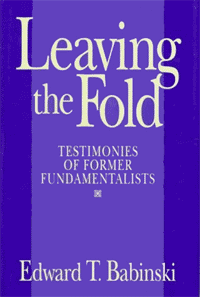
Leaving The Fold: Testimonies of Former Fundamentalists

Leaving the Fold by Edward T. Babinski
Product Details
Paperback: 462 pages
Publisher: Prometheus Books (June 30, 2003)
Language: English

Contents

Acknowledgments

Introduction

1. What You Should Know About Fundamentalism

2. Fundamentalism's Grotesque Past

3. Testimonies of Former Fundamentalists Who Are Now Moderate Evangelical, Liberal, or Ultra-Liberal Christians
  • Dewey M. Beegle: Journey to Freedom
  • David Coffin: Fundamentalism: A Blessing and a Curse
  • Harvey Cox: An Ecumenical/ Evangelical Dialogue
  • Tom Harpur: Heaven and Hell
  • Conrad Hyers: The Comic Vision
  • Dennis Ronald MacDonald: From Faith to Faith
  • David Montoya: The Political Disease Known as Fundamentalism
  • Marlene Oaks: O1d Time Religion Is a Cult
  • Robert M. Price: Beyond Born Again
  • Arch B. Taylor, Jr.: The Bible, and What It Means to Me
  • Mike and Karla Yaconelli: Behind the Wittenburg Door


4. Testimonies of Former Fundamentalists Who Are Now Adherents of Non-Christian Spiritualities
  • William Bagley: Reflections on a Christian Experience
  • Ernest Heramia: The Thorn-Crowned Lord/The Antler-crowned Lord

5. Testimonies of Former Fundamentalists Who Are Now Agnostics


6. Testimonies of Former Fundamentalists Who Are Now Atheists
  • Dan Barker: Losing Faith in Faith
  • M. Lee Deitz: My Conversion from Fundamentalism
  • Timothy William Grogan: Lies, Damn Lies, and Boredom
  • Jim Lippard: From Fundamentalism to Open-ended Atheism
  • Harry H. McCall: "Who Do Men Say That I Am?"
  • David N. Stamos: Why I Am Not a New Apostolic
  • Howard M. Teeple: I Started to Be a Minister
  • Frank R. Zindler: Biography


7. Testimonies of Former Fundamentalists Who Played Major Roles in Liberalizing the Religion of Their Day
  • John William Colenso: The Heretic
  • Robert G. Ingersoll: Why I Am an Agnostic
  • Charles Francis Potter: Thee Preacher and I
  • Henry Preserved Smith: The Heretic's Defense


Appendix A: The Pentateuch and Book of Joshua Critically Examined by J. W. Colenso

Appendix B: The "Roman Road to Salvation" or the "Synoptic Road to Salvation"? Belief or Ethics?

Appendix C: Assorted Quotations that Address Various Aspects of Fundamentalism

Appendix D: A List of Additional Testimonies by Former Fundamentalists and Related Resources

Index


Leaving the Fold - Additional Testimonies

A List of Women Who Leave The Fold - Women Speak Out


note of thanks

From: Becky Shankle
To: Ed Babinski

Ed-

I started reading your book Leaving the Fold this week, and I have to extend a GIGANTIC thank you for writing and getting it published! I'm so relieved that someone out there is using their brain to combat the wrapped-around-the-axles logic that fundamentalists employ rountinely. I've found it very difficult to even have a rational conversation with these people, so I don't. They are so busy quoting the Book they don't listen, and are extremely defensive! I got the book primarily to understand my born again sister, and am hoping she'll return from the obssession at least in part someday. There are several others I run into regularly (I live in NC, and my Dad lives in Greenville SC) it will help me to deal with as well.

Thanks so very much for being bold enough to put it out there. I can just imagine the hate mail you must get! So count mine on the good stack. :)

Becky Shankle
Raleigh NC


From: "Harry N."
To: Edward T. Babinski
Sent: Thursday, September 11, 2003 9:20 AM
Subject: Leaving the Fold

Hi!

I recently got my hands on a used copy of your book "Leaving the Fold" and have to say it is really an outstanding collection of the experiences of the individual authors. It's also a big plus reading the experiences of people who have spent years studying Christianity and the Bible from all angles and being able to tap into their knowledge. As I've come to learn over the last many months doing my own "seeking", it can be a daunting task to review the historical context of the time, the competing mystery religions etc etc.

Anyways thanks for a great book

best regards
Harry


Hi Ed. I love your book. Are you considering a sequel? I notice your book calls testimony a powerful force for those leaving the fold. But don't you feel that folks in your book also want to give their testimony so they could at least attempt to come to terms with why the did what they did and why they thought what they thought? I know that I'm haunted by my religious past every day. If I were to write my own testimony that would certainly be part of my motivation. Anyway, congrats on a great book.
P. Stromberg
Pacific Northwest Skeptics


Mr. Babinski, I read "Leaving The Fold" a couple of months ago and found it extremely helpful and fun to read. I want to personally thank you for putting together such a book. What do you do these days? Write, lecture, or teach? Thank you for your time,
Paul

Banned Book: About Leaving the Fold by Edward T. Babinski

"The book was recently removed from the shelves of the Anderson County Public Library in South Carolina (Babinski's home state), due to complaints from patrons. The book contains nearly three dozen first-hand testimonies from former fundamentalists who have become liberal Christians, agnostics or atheists. According to Babinski, 'I've tried to get the local newspaper to interview me since writing my book, but they never had the time. Sales have been slow. Now, miracle of miracles, the book is being mentioned in newspapers, television and radio. God bless those Christians!'"

The Secular Humanist Bulletin

Your comments are welcomed!


Controversial Book: "Leaving the Fold: Testimonies of Former Fundamentalists"

by Edward T. Babinski

This book is primarily a collection of testimonies by people who were Protestant Christian fundamentalists and who later left fundamentalism (with the exceptions of Tom Harpur and Harvey Cox, who were moderate Christians whose views underwent a broadening similar to what some fundamentalist contributors experienced).

A hard-line fundamentalist may wish to warn the authors of this book's testimonies, and anyone reading this book, that "hell" is probably their "next destination." But he will have to do better than that if he hopes to convince his former brethren to rejoin him in his "straight and narrow" appreciation of the Bible and Jesus. He may even have to read this entire book to understand where his former brethren are "coming from" rather than simply predict where he thinks they are going.

I first tried marketing this book in parts. The testimonies of those who had left fundamentalism but remained Christians were to be published by a moderate liberal Christian press; the testimonies of those who had left both fundamentalism and religion were to be published by an atheist or agnostic press. However, some testimonies, such as those by William Bagley and Ernest Heramia, did not fit easily into either category.

I contacted several moderate and liberal Christian publishing houses and found that none of them were interested in "testimonies." I think that is a defect of moderate and liberal Christian sensibilities. Perhaps they do not wish to "lower" their standards, so to speak, by copying confrontational evangelistic techniques used by conservatives and fundamentalists, one such technique being "testifying." (Can I hear an "Amen," brother?) Yet personal testimonies are remarkably effective at conveying feelings, not merely facts; deeds, not merely dogmas; and they incite people to act as well as to think. For many years evangelical Protestant Christianity has used the power inherent in a single person's "testimony" to win new converts and buoy the faith of old ones.

So, after several rejections from moderate and liberal publishing houses, I offered the testimonies to the largest free-thought press in America, Prometheus Books. At first I was skeptical whether a "free-thought" press would print testimonies by people who had remained Christians, but I was assured that promoting genuinely free thinking was more important to the press than selectively chopping up every hundred-thousand-word manuscript they bought until it resembled a ten-page primer for atheism. Prometheus has published three full-length autobiographies of people whose faith in Christianity was shattered after they had witnessed the unethical or demagogic practices of church leaders and the naivete of their followers (i.e., Salvation for Sale, Don't Call Me Brother, and Jesus Doesn't Live Here Anymore). None of the authors of those books is an atheist. Furthermore, printing only testimonies advocating atheism would be to fall into the same error as that of the fundamentalists, who feel it imperative that everyone believe exactly as they do.

I suppose that the nearest that fundamentalist Christians ever came to advocating greater diversity rather than greater uniformity was when Jerry Falwell founded the Moral Majority, which, until its demise in 1986, focused on the moral (and political) concerns of Protestants, Catholics, and Jews. Considering what fundamentalist Protestants teach about the grave errors of Catholicism (not to mention Judaism), that was quite an amalgamation for a fundamentalist like Jerry Falwell to construct. But, as they say, "politics makes strange bedfellows." For that matter, so does televangelism."

(Chuckle.)

This book exemplifies how an even more diverse array of people (far more diverse than the Moral Majority) is willing to band together to speak out on an issue that has intimately affected all of them, hoping thereby to increase the volume and scope of their declarations.

Once you have read all the testimonies, certain threads linking them together become apparent: the dilemmas and fears each person faced in leaving fundamentalism behind; their gradually dawning courage to ask crucial critical questions, and to continue asking more questions; their discovery of how wonderful it can be to allow one's innate curiosity the freedom it craves; and the blossoming of their distinctive personalities and beliefs. Anyone who enjoys a novel with idiosyncratic and markedly diverse characters will enjoy reading what lies ahead.

Of course, people who have left fundamentalism can differ markedly in their reactions to it. At one end of the spectrum are those who bid fundamentalism a "fond farewell." They had fun as fundamentalists, particularly in their youth. They also remind us that belonging to a fundamentalist church is a healthy alternative to drug addiction, alcoholism, and crime. A fundamentalist church setting can provide some with the social and psychological context that helps them to legitimize and catalyze radical changes they wish to make in their lives. (Of course, individuals must also want to change in the first place. No mere context can do that for you, as groups like Alcoholics Anonymous have pointed out.)

At the other end of the spectrum are those who aim both barrels at their former fundamentalist lives and beliefs. They view fundamentalist organizations as robbing people of their money (through "tithing," "giving till it hurts," and phoney come-ons to garner more contributions than a television ministry knows what to do with); robbing people of their time (every minute involved in church activities); robbing people of their health (phoney promises made by "faith healers"); and robbing people of their individuality, their freedom of thought, or even their ability to appreciate life.

Both perspectives can undoubtedly be true, depending on each individual's personal experiences. It was left up to each contributor to discuss in whatever terms they chose their entrance into and exit from fundamentalism, and to explain where they are today.

If you are a Christian, you may be interested primarily in testimonies by former fundamentalists who remained Christians. If you are not a Christian, but open to non-Christian spiritualities (wiccan or eastern), then you may find testimonies of that nature more to your liking. If you "don't know" which part of the book you might enjoy reading first, try the testimonies of those who became agnostics. If you are an atheist, your curiosity may be peaked by that section. Or, if you are a historian, you may wish to flip to the final section of testimonies of historical figures.

Readers of all persuasions should peruse the annotated bibliography that lists further testimonies. Or, you may wish to advance directly ahead.

© 2003

Preview This Book

Read the Editorial Reviews

Read the Reviews by Other People